Saturday, November 28, 2015

47 Incremental, cumulative change or drastic disruptions?

It’s common to hear that things need to be changed drastically, that the whole existing structure has to be thrown out, a whole new generation of people has to be brought in, and so on. This attitude developed especially during the 1980s onward, when leaders like Thatcher in the UK and Reagan in the US attacked the entrenched interests and structures that were resisting the open or liberal economy. With the  collapse of the soviet socialistic bloc and the exposure of the weaknesses of centrally planned economies, many other countries, even communist China in the 1980s and quasi-socialist India in the 1990s, decided to switch to less controls, more free market in their economic systems. The initial success of this change-over encouraged people to search for those critical ‘game changers’ that were required to set them on a totally different growth path. Thus the tendency during the recent decades for the drastic transformation as the spirit of the times, bolstered by ideas such as the American economist Schumpeter’s concept of the ‘destructive creativity’ of capitalism.

But here’s the thing: in our daily lives, we may not have such opportunities all the time. There are some situations in which, perhaps, a sudden and drastic change of the set up is possible and even desirable (my favourite example is using a change of place to stop habits like smoking!), but mostly drastic changes are a big challenge and an imposition in themselves, rather than a boost to a whole new trajectory. So much of the average person’s effort and ingenuity has to be dedicated to just arranging matters again after a change The transactional costs, in other words), that little is left over for a grand new venture. Indeed, one has to use all the strengths and resources garnered in the old system to stabilize the new structure, so there is no thought of jettisoning the old completely. The more the change, the more of the same thing, as the wag so wisely remarked (I think it was Oscar Wilde, in French). As we grows older, the range of possibilities also contracts inevitably and inexorably, so once again we’ve got to work with what you have rather than dream of starting afresh on a clean slate.

Each one of us has a severely limited scope of drastically transforming our circumstances. Mostly, the external world is a given, and we have to settle for some idea of our place in it and the extent that we can draw support from it. It may appear that a drastic change of job, or place, or spouse, would open up our lives, but it may be more resource-effective to instead list out the positives in our exiting situation first ‘before giving up our day job’, as the saying goes. This does not mean that we should never embrace change; the point is that we should check first whether we have really extracted all that is possible from the existing situation, and whether we honestly expect something more or better in the new situation. If we have been ineffective or neglectful in addressing difficulties and bottlenecks in the past, how are we sure that similar obstacles will not crop up in the future scenario as well?

That is, we should avoid the blunder of comparing the worst of our existing situation with the best of another (mostly) imagined set up. A sober analysis should include both potential losses and gains, the ‘pros and the cons’ of each alternative, and then strike a balance. Unfortunately, as societies modernize, the individual is freed more and more to pursue their individual, private search for the best deal, leading to such social changes as higher divorce rates and lower commitment to others’ interests, and so on. Psychological disorders, stress, suicides, and so on  are often indicators of this (futile) quest for the ‘pot (of gold) at the end of the rainbow’. Alas, there is no end of the rainbow, not pot, no gold, but perhaps beneath your feet at the very place you are standing on, there is something, a possibility of improvement.

I can cite a couple of examples. A new ruler, they say, starts by rearranging his generals. A modern state does not have this luxury of seeming action, but there is a great temptation to start ‘new’ institutions. I put that in quotes, because, as Oscar Wilde hinted it’s very often the same old same old, just dressed up in new colours to fool a believing public. A classic example (for the Indian context) is the winding up of the Planning Commission of India by the Modi  (NDA) government, maybe because the new PM felt that the Commission’s petty functionaries had exercised too much budgetary control on the elected state political leadership. But here’s the irony: they went ahead and set up a new institution called the National Institute for Transforming India (acronymed NITI, which means ‘policy’ or ‘strategy’ in Hindi/Sanskrit), but with the same staff and infrastructure. They could as well have saved themselves all the trouble and bad press, and just clipped the mandate of the original Planning Commission -- an incremental change (see this article of mine on forestry in the Planning Commision). Of late, the ruling party has come round to the realization that they can’t bulldoze through drastic changes without taking the opposition along, and they seem to be climbing down from a ‘game-changer’ to an incremental mode! The previous UPA government, too, was a captive of the ‘game-changer’ syndrome, as they tried to repeat the success of the 1991 liberalisation strategy in the 2000’s; the tendency was to berate existing institutions like the existing civil services, the research institutions, the public sector undertakings, the existing infrastructure, schools, colleges, and so on, trying to shift much of this to the private sector and NGOs, and so on. The constant criticism of existing structures only served to spread a pall of gloom about the country’s situation, so that indeed the UPA government could be said to have snatched a resounding defeat from the jaws of victory in the 2014 elections.

Unless you’re a leading business magnate who can hire and fire regardless of other considerations, you will have to pursue change within the constraints of keeping the existing institution going --  it may be a corporation, a lab, an academic institution, or anything. Take a research institute: you may think this one has to be closed down and a new one started ithout all the baggage, but there is no doubt that the new institute will also suffer from the same problems, whether it is budgetary support, or recruitment of the best personnel, or lack of financial delegation, or interference from others, or whatever. Much of the administrative effort   in setting up a new institution – getting the statutory clearances, finding land, finances and other resources, setting up a management structure, procuring hardware, and so on – would be a waste of time, as you would only end up again at the beginning, at ground zero, as it were, and would have to face all over again all those problems that bedevilled the old institution.

It might well be a much wiser use of the limited managerial resources, and your own limited time and tenure, to actually deal with the real problems in the implementation of the ongoing programmes of the existing institution, in an incremental fashion. Trying to wind up the old institution would not only sap your own energies and waste your own time and talents, but also create a huge hostile force that would have a stake in your failure. The corrosive effect of the negative ‘narrative’  required to trash the existing institution would also have far-reaching, and damaging, effects on the credibility and morale of the new set up as well.


Of course, if you are mentally decided on  a change, then perhaps no rational analysis is going to slow you down; but would be advisable to limit such impulses to the relatively minor decisions like getting a new car or computer or smartphone!

Saturday, October 31, 2015

46 Getting it right – the first time around

To be most effective and use our time and energy optimally, we have to develop the habit of doing things as thoroughly as we can the very first time we do it! I think I’ve said something about this before, but it bears repeating.

It’s true that a positive attitude says that one should always give a second chance, and not write off something or someone based on first impressions. But then situations in our fast-moving world often just don’t have the wherewithal to offer that second chance. This is where a consistent approach of doing as complete a job as feasible the first time itself will increase the success rate in the long run.

One of the activities in which the first-time-best principle always seemed to kick in was in photography, of all things! When out in the hills, you walk round a bend, and a fantastic vista opens out. Or you may be driving, and as you crest a slope, a broad valley spreads itself in the evening light. Stop and take a few photographs! You may think that you can get the scene on your way back, but the light may not be good, the point of view not so perfect (imagine having to walk or drive with your face turned backwards!). You may not even come back that way on your return trip! So stop the car, get down and use your best technique, and capture the light! Take off the backpack, wipe your forehead, and take the trouble of taking those perfect shots!

One of the common sayings in hobby photography is “f8 and be there”. Turning this around, it could also mean “Carry a camera wherever and whenever”. “Be there” is wherever you happen to be! I still regret not following this advice on all my field trips and official tours, because there is no way I’m going to be able to visit so many field spots by myself. So most of us are reduced to taking snaps of the cat or the dog.

Another activity in which I find the truth of this principle, every day almost, is in reading and writing. In the course of any substantial writing project (say a term paper or a thesis), we are tempted to write very sketchy outlines as we go along, hoping to be able to hunker down in the final couple of months or weeks and produce the final masterly version. But then we find our references are all over the place, we are unable to locate many of them, we are unable to understand our own notes, and the subject has become so stale we feel like tossing the whole lot into the can. Writing requires a certain state of euphoria which comes only the first time we explore a subject; sadly, almost everything goes flat when kept too long. So here’s where we should sit down and write what looks like the final version from the start, just as if we are not going to be able to revisit that part again. The last time I did this was my for my fellowship which got over just a month back (hence the gap in postings). Luckily, I had followed the principle of composing more or less the final draft during the  entire two-year period. I found that there was no way I could go back and redo any of the earlier chapters in any depth… but since I had written them up exactly as I would a final version, complete with references, page number citations, and so on, I had very little editing to do at the final stage. I was able to print out and deliver the mandatory three copies of the report, and even submit it for publication, and vacate my room on the last day of the fellowship. This was providential because I then went and broke a leg (my own, to clarify) – meaning that there would have been no scope for going back for any work after the final date!


So that’s the other reason we need to take each opportunity or challenge as the real thing, and not as trials. We don’t know what nasty surprises the future has waiting, so most of our achievements are as they are fashioned during the run-up. As the saying goes, life is what is happening  even as we’re planning it the way we imagine it should be. Let’s not leave it to the next assignment, or the next meeting, or the next visit to our parents or visit from our kids… let’s be a good friend or family member right now, with whoever is around, let’s get it right the first time around, as it’s happening in the here and now!  

Friday, April 24, 2015

45 On working to a PhD

Getting a doctorate by research is probably the most challenging pursuit any of us will possibly contemplate. In my experience, it is an ultimate test of character, rather than of intelligence or knowledge. It’s what most of the young people at my institute are engaged on, and what many others (including a few retired ones!) may get interested in. Here’s my own take, from doing a PhD in the University College of North Wales, Bangor, during the 1980s; things may be a little different in other places, in other times, but maybe my experience may be of some interest or even guidance to someone struggling with this great undertaking!

A doctorate is a sort of crowning achievement of one’s academic career. Conversely, it is not an essential qualification for a satisfying professional life. Practitioners in the field may even harbour a thinly veiled contempt for the PhD, as practical experience is deemed to be more valuable to society than mere academic learning. In fact doing a PhD is sometimes viewed as an escape from the drudgery of a mundane job, a way of extending adolescence, as it were. It separates out the ‘men’ from the ‘boys’ in popular parlance (if the sexist bias can be condoned!). It is true also that sometimes an academic stint is a welcome break from the frustrations of a job or career, especially if one is getting shunted to the backwaters or  waiting for the next promotion.

One has to accept that doing a PhD is one of the most difficult and challenging undertakings a person could think of, and so the choice between the drudgery of the regular job and the relative freedom of an academic life has to be made with full fore-knowledge, even if it is going to be a temporary commitment. The difference between practicing in the profession and doing a doctorate is that the doctoral aspirant has to identify his or her goal and purpose all by themselves, not to speak of working out an acceptable theoretical framework, methodology, exhaustive survey of the state of knowledge, and the actual field work. The practitioner, on the other hand, usually has these main aspects of the job already laid out and defined; responsibilities are clearly specified, operational practices are spelled out, and standards also clearly laid out. So the individual has very little to add except a work plan.  A normal job is also usually not an isolated undertaking, as there is usually a team and an organization to take you along and forward, and any deficiencies in individual members are nicely made up by complementary qualities in the others. The system carries all of us along.

Doing  a PhD, on the other hand, is one of the most painfully isolated and isolating endeavours a person can take up. It is not for nothing that the scholar is popularly imagined as locked up in an ivory tower, agonizing over some intricate problem or pondering some great mystery. Usually, of course, the scholar is breaking his head over some obscure arguments or trying to make sense out of someone’s opaque writing. The PhD scholar has to master the bulk of work in his chosen field and topic, then think of something new in it, and develop it into a study and thesis.

Before this, of course, the aspirant has to zero in on a field and topic. For a person just out of a master’s course, this may well be the most challenging hurdle. This is why it may indeed be advantageous to get into the real world first and work a few years in the field, even if there is an underlying intention of doing the PhD at some point. The years in the working world give substance and life to the dry theories studied in college, and also give time to understand the priorities and identify some promising avenues for expanding or extending what one has studied. If one keeps alive a sense of curiosity and self-observation in the field, certain problems or issues or situations may present themselves that can be fruitfully developed into a thesis. The PhD topic and title then formulate themselves, over the course of the few years spent working in the field, without the intense search that characterizes the first year of a fresh graduate’s attempt. One’s approach to the field of specialization may also shift, maybe from science to management, or technology to psychology, and so on. In some cases, the very field of interest itself changes: it is not at all certain that one’s career will develop in the same subject as the first degree!

If you do join the PhD programme without a clear conception of the topic, then be prepared for a longer induction period, which may entail at least a year of assiduous reading, in greater depth and width compared to your undergraduate days. This means, that you will read in a wide variety of topics within your broad area of interest, but pursue certain selected topics to greater depth.  All the basic literature in your field will be a part of this initial grounding, but you will also take up more detailed work in some topics, perhaps referring to journal papers, even visiting the field to look at some aspects first-hand, or having discussions with learned people. It will be difficult to keep a focus during this period, but I feel this will the most valuable part of the PhD experience, that will provide a base for much of your future work, looking beyond the narrow focus of the PhD thesis. This initial period of learning is like an ‘internship’ or ‘apprenticeship’ that will give you the academic maturity needed to formulate your research work, even though you may find that much of the work done during this initial, exploratory phase, will not actually find a place in your final thesis, but may be useful much later on as you come back to it to follow up individual lines of interest in later years.

Toward the later part of the first year of reading, hopefully  certain ideas will start occurring to you that you feel can be worked into a cogent research proposal or outline. Perhaps some modification occurs to you in the assumptions or construction of the models people have been using in your field.  Perhaps a straight application of the existing principles can be made in a new geographical region you are familiar with that may throw new light, and so on. Or perhaps you are thinking of contrasting situations that can be studied to test some hypothesis (case studies are useful, since controlled experiments are usually not possible in sociology or institutional studies).

Intense reading is difficult to sustain over long time periods, and you will have to do it in short chunks of an hour or two at a time, followed by some different activity (or a bit of relief with your fellow-scholars at coffee!). In my case, the peer group (overseas students, most of them working professionals back home) used to have a rollicking time over extended coffee hours… the PhD scholar is a pitiful specimen, and people tolerated our whiling away hours in small talk, gossip and joking about English culture (our Celtic hosts loved to join us in rolling the heads of the Saxons!). The brain is often working best when you have given it a rest… over  a long period of months, your ideas will arrange themselves into some sort of a cogent structure.

By this time, therefore, you will find ideas forming in your head that can be naturally and easily developed into small notes or outlines for a study or paper. This is the time to start writing! And if you can get feedback from your supervisor or trusted colleague, all the better. Some of these topics may appear really boring at the outset, because you have to collect a lot of detailed material, but once a certain mass of material has been so collected, the subject will start getting a life of its own, and begin to appear more interesting and feasible. As it gains substance, it will start appearing familiar and viable!

We will expect this process to lead naturally to one or a couple of serious research topics for your PhD thesis. This is the time to start putting together all the basic literature and sources of data, and even drawing up a tentative chapter list, and designing tests, surveys or experiments as the case may be. These can be tested in the exploratory phase, some field data collected, then fine-tuned and agreement reached with the supervisory team. The second year, then, will be engaged in serious work on the core topic or couple of topics, collection of data or field surveys, collation and analysis. At the same time, you may have to reorganize the literature and background material to reflect the topic you will be focusing on. Hopefully, by the third year, you will have enough material to write up in a systematic and rigorous way.

Here’s a couple of hints to make the writing process a little easier and faster. First hint: during the initial, reading, phase, bookmark any quotations that strike you in any way. In the old days, we used to literally create a physical bookmark, i.e. a slip of paper, on which we would write out the quoted sentences. This is done now with computers, obviously, and you could even scan the page or paragraphs required and save them a file. Now the real hint here is to record the exact reference to the source when you enter the quotation, just as if you are citing it in a paper, complete with year, edition, publisher, and page numbers  because after a year or two, it may become difficult to trace the actual source publication. In other words, get it right the first time around! It will save you endless searching later on (which will take time away from your researching!), even if much of the material you collect is not used in the actual thesis (it may be useful to you many years down the line, when you are writing your other papers!).

The second hint: don’t start your writing with the introductory chapter! Of course, you could draw up a list of section headings for the chapters, to keep you from overlooking any important aspects over the course of time, but usually, if you sit down to write your Chapter One, you will find either that you are unable to start (writers’ block), or that your introduction goes on and on until it reaches an encyclopedia size! The alternative, which I am suggesting based on my own experience, is to leave the initial chapters in an outline state for the time being, and concentrate instead on your actual work and analysis, from which will emerge your main conclusions and suggestions for policy and future work (the last chapter!). So, contrary to our management gurus, I am suggesting that you put the last thing first! After you have the draft of the final part, you will feel more confident, and you will have a good idea of how many pages you will have for the introductory portions. Since you wouldn’t want your thesis to exceed some 200 to 250 pages (max!), you will be able to draft your introduction, lit. survey, methodology, etc. in the most efficient manner, saving time and effort that you could put to better use in polishing up your later chapters.

When I was in the initial phase at Bangor, my supervisor told me that the British system didn’t give so much importance to guiding the scholar, as to the individual’s own ideas and initiative. According to him, he would be lucky to see his guide once at Christmas every year, so we should count ourselves lucky that we were able to see and talk to our guides almost every day during the coffee hour! Even though we were able to see them, we would find it difficult to initiate serious academic discussions; this is understandable, since we had to first go through the basic reading phase before we were in a position to actually benefit from any discussion! This gave us enormous freedom, but kept us awake nights wondering what we were doing! I even got my hands on a book by Phillips and Pugh, How To Get a Ph.D. A Handbook for Students and Their Supervisors, to help me understand the process in the UK! I guess it comes down to your particular situation and style of functioning in each case (this book even has a chapter on how not to get a PhD!). I notice that the approach is different in other systems, and in my current institute, for instance, I find much closer supervision throughout the PhD.

A final word: this business is a test of character, because you have to have the grit to stay with the process until you are over the hump and coasting to the finish. The biggest hump, in my experience, is settling on the actual topic. If you register without a clear idea of this, you will have to go through that initial phase of reading widely and deeply to get a hang of the field and its possibilities. If you have come back to academics after a few years working, you may have a better idea of the area in which you want to work, and your reading may then be much more focused and detailed in that area; you may also have a certain body of information and even specific data that could make it easier.

Sometimes, because you are basically applying someone else’s thinking to your chosen area of focus, you may yourself not have a clear picture of your own work. That was the case with my PhD thesis; indeed, because I got what I thought were less than satisfactory conclusions, I had been a bit puzzled and deflated all these years, until I got a flash of intuition of the real meaning of my thesis just a few weeks back (after over 30 years!)… if you’re interested, look up my article here: http://forestmatters.blogspot.com/2015/02/13-applying-economic-analysis-to.html. The point is, that it takes time for ideas to develop, and even more for understanding to mature. The PhD award itself only certifies your basic ability to hang in there for a few years and complete the project; it is merely a license to go forth and practice, and does not make you an ‘expert’, which can only come from years of activity in the field.

References


Phillips, Estelle M. and D.S.Pugh. 1987. How To Get a Ph.D. A Handbook for Students and Their Supervisors. Indian edition, 1993, published by UBS Publishers’ Distributors Ltd., New Delhi, by arrangement with Open University Press, Buckingham.

Sunday, March 1, 2015

44 The power of focus for the 'Renaissance Soul'

Margaret Lobenstein describes the multi-interest character as The Renaissance Soul; such persons tend to get excited by many things at a time, but find it difficult to choose; love new challenges but once these are mastered, get easily bored; take up many hobbies briefly; feel trapped and restless even in successful jobs. They want variety and fresh challenges all the time!  In her 2006 book, this pioneering inn-keeper turned life and career coach has many suggestions to get such a life while still making ends meet.

The essence of Margaret’s advice is expressed in these three points: firstly, get focus, so that you are able to get into action; secondly, get money by “linking your passions to a source of income”; and how to organize your time to match your “Renaissance soul rhythms”. Regarding the second (income), she suggests many options to finance your wanderings and love of variety: pursue different careers, sequentially; or get an “umbrella” job that “embraces many interests”; get two jobs rather than one; get a J-O-B that “serves one’s interests”; or even a “single career path”  that allows you to accommodate many interests. I think I got lucky with the last alternative, as a career in the forest service allowed me not only to indulge my love of nature and travelling, but also gave me the time and the support to pursue higher studies, occupy positions in different fields and levels in general administration, teaching, research, policy direction, even the corporate world, apart from developing other interests and hobbies on my own, like music and photography. Plus, as I explained before, it gave me a good retirement scheme – enabling me to satisfy both passion and pension!

An initial exercise recommended by Margaret Lobenstein is to identify your five or half a dozen core values that you feel are most important to you now, from a list of fifty or so. You could also match your life goals (from a list of ten or so) to circles of different sizes to get a feel of their relative importance to you. She also gives you the ‘obituary test’. Once you’ve done these self-discovery exercises, you are supposed to find it easier to reorder your life to give more space to your highest priority values and goals.

The book suggests that one way to move out of the paralysis of choice, and achieve more of your Renaissance soul goals, is to narrow down your priorities to four or so activities at a particular period in your life, or to identify your focal points. This is an acknowledgment, of course, of the limitations on every person’s time and resources. It will be impossible to do all those fifteen activities you are fascinated by, all together, so the strategy is to dwell at a time on a short list of three to five (“When it comes to Focal Points, four seems to be a lucky number  for Renaissance souls”). This would be akin to the Serial Master type of Scanner in the previous post (Barbara Sher’s book): they get their variety, plus they are able to get on with some activity instead of being eternally undecided and flitting from idea to idea. As you get into each of these limited areas of interest, you may find you’ve had enough of some of them, and can happily retire them in favour of other, more interesting activities. Of course, if you do not want to abandon them altogether, then you will have to keep them on the ‘back burner’ till you are done with the other choices, and circle back to them at a later period of your life like the cyclical Scanners of the last post.

An interesting part of the book is the advice on how to bring the circle of passions and the source of income closer together. Margaret calls this the J-O-B, spelling it out letter by letter,  as distinct from a routine soul-deadening livelihood as in ‘don’t give up your day job’. One has to pick a J-O-B that in some ways complements the focal points of one’s real interests and values. These are the five possible benefits of a J-O-B: it could be a source of income, a source of energy (not competing with the focal point passions!), a time saver, a way of getting training or equipment, or a means of networking. The J-O-B chosen should supply at least a couple of these benefits.

Personally, I am not quite sure that a series of temporary positions will amount to a satisfactory career in the long term, but I suppose the job situation is different now, as many youngsters do want to build up their own outfits after a few years of working for others. A variety of occupations and experiences may be advantageous here. A lot of people are trying to combine a love of outdoors with photography, conservation, or with a business like running a resort or a tour outfit, or running nature camps for kids, for instance. It may be interesting to do a little study of where they all end up: as publishers or film makers or restaurateurs or directors of NGO concerns – or political activists?  To give the author credit, she does advice that even if the day job amounts to a long-term (full time) career, it should be used to advantage to support the passions, by thinking of it as a J-O-B rather than feeling handcuffed and frustrated by its demands on your time and energy. I think I like this option, as it may save a lot of young people from going astray in pursuit of moon dust! Another interesting and fruitful idea she offers is to find an “umbrella” career position that can provide a legitimate job title as well as a cover for your current focal points.

There’s lots more good advice here, including suggestions for young people in choosing courses at school and college. A point I really like is that you may be attracted to a process of learning some occupation, but may not really be inclined to take it up as a career: “sometimes success rests not in the product but in the process”. She suggests the PRISM test of the current Focal Points to identify your priority interests: the test of Price, Reality, Integrity, Specificity and Measurability. This jargon should appeal to the management-oriented types amongst the Renaissance souls (or Scanners, if you prefer).

Most of us have probably experienced short periods of intense immersion in some project or activity under the pressure of some deadline or obligation, when things seemed to come together of their own and our inner system seemed to be humming along powerfully in synch with events in the outer world. The author Robert Greene in his book Mastery describes the experience of focus this way: “Instead of flitting here and there in a state of perpetual distraction, our minds focus and penetrate to the core of something real. At these moments it is as if our minds – turned outward – are now flooded with light from the world around us, and suddenly exposed to new details and ideas, we become more inspired and creative... Once the deadline has passed or the crisis is over, this feeling of power and heightened creativity generally fades away. We return to our distracted state and the sense of control is gone. If only we could manufacture this feeling, or somehow keep it alive longer… but it seems so mysterious and elusive.”  

And yes, Margaret does have a Focal Points workbook to maintain, with one section for each Focal Point (and a miscellaneous appendix for all the rest!). Like I said in the last post, this is my weak area, and I tend to just keep a very untidy daily cashbook sort of diary with a running list of ideas and things to do, rather than formal work charts or critical path charts (“working backwards from the goal”). I’m sure by now that I will be neither opening resorts nor running NGOs, and I will be amusing myself by myself in my own way - but perhaps you may be made of sterner stuff!

Books cited

Greene, Robert. 2012. Mastery. Profile Books Ltd., London.

Lobenstine, Margaret. 2006. The Renaissance Soul. Life Design for People with Too Many Passions to Pick Just One. Broadway Books, New York.


Sher, Barbara. 2006. What Do I Do When I Want To Do Everything? A Leading Life Coach’s Guide to Creating a Life You’ll Love. Rodale International Ltd., London.

Saturday, February 28, 2015

43 The Scanner take on multiple vocations!

We’re still on the subject of doing many things at a time, or over a lifetime, which we started with in the last post. Like I said, there are a couple of books which address this very topic in detail. The first of these is What Do I Do When I Want To Do Everything? by Barbara Sher, sub-titled “A leading life coach’s guide to creating a life you’ll love”. Barbara’s main plank is that people who like to keep trying new things, never settling down to one vocation, much to the frustration of their families and well-wishers, may be just made to be learners throughout their lives. She calls them (us!) “Scanners” (I will use the word always with a capital S, to give it a proper weight and dignity, like President or Comptroller).

Apparently it is the process of taking up a subject or field of activity and studying it deeply enough to be competent in it, that motivates Scanners. I think I meant something like this in a previous post (#37 To find a purpose) when I talked about making the process itself interesting so that one is not too involved in the results. For Scanners tend to leave the subject when once they have achieved a certain level of familiarity; they are not in the game of doing the same thing over and over again as a job… sounds familiar!

Sher has a detailed typology of Scanners: we can be Serial Masters, who like to take up one thing at a time, master it, and then abandon it; or Cyclical Scanners, who tend to circle back to older interests over a period of years (my front burner - back burner idea makes me this type, I guess). Others are Samplers, who like to try a number (dozens) of things, without going too deep into many of them. Whatever type you are, Sher’s message is that it’s alright to be like that, even if you don’t get to leave behind a legacy in any of them.

One of the most useful (if that can be said of any Scanner activity!) is the idea of keeping a Scanner Daybook, to record all your fleeting inspirations and ideas every day by the hour. The way the author describes it, it is meant to be a sufficiently heavy and impressive looking tome, preferably well upholstered and fit to display on its own stand (like an illuminated bible or domesday book or something!), with large unlined pages to receive your thoughts, compositions, drawings, recipes, samples and memorabilia, like da Vinci’s notebooks. I gather that the idea of the Daybook is to use one pair of open pages for each idea or project that occurs to you, and keep on opening new pages as each new idea strikes your mind. Over time, it is supposed to end up as a complete store of all your ideas, even if you haven’t acrtually worked through any or most of them. As you add detail or achieve progress, I guess you are expected to fill in notes in the two-page spread over the years.

I have to confess that this may be a bit beyond my persistance and work habits, although the idea sounds good. I have so far used a series of discarded diaries for my note taking, using separate ones for my work-work activities (mainly the light-weight, flexible, spiral-bound notebooks they hand out in seminars and training courses), which last up to a month each, and a separate series for my project ideas, for which I use the out-of-date hard-bound diaries that accumulate all the time (of course, they have all sorts of other matter printed on each page!). These latter are my version of the Scanner Daybooks, but far from looking like a beautiful souvenir, they are full of dense scribbling that I myself sometimees find it difficult to decipher!

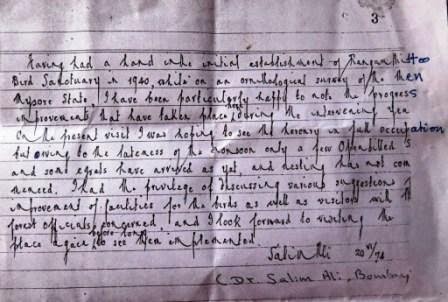
I have seen two examples of the beautiful life-time records that Sher is apparently thinking of. One is the field notebooks of the famous Indian bird specialist (ornithologist), Salim Ali: he has recorded each day’s notes in a beautiful handwriting, complete with drawings and other stuff. I guess they are preserveed in the Bombay Natural History Society at Mumbai, but I saw one sample kept under glass at the Sultanpur bird sanctuary near Delhi many years back. I haven’t been able to locate any scanned images of his journals, but here’s one, of his handwritten note at Rangantittoo bird sanctuary near Mysore, Karnataka.


The other example was the field diaries maintained by the professor heading the Centre for Development Studies, Swansea,  whose system was even more elaborate. He used to record his notes in two copies (using pencils!) through a carbon paper, and then he’d tear away the duplicates and sort and file them classified by topic, while the original would be stored away obviously in order of date (year and month). So his study would have these arrays of identical looking diaries, and the loose sheets would have been filed away in their separate folders, subject-wise.

I never tried to emulate Salim Ali’s system (it was just too perfect!), but I remember I did foolishly try the good professor’s, but I gave it up after a few days and reverted to my shabby system of a running entry of notes on everything (including the daily to-do list!) in a series of mismatching notebooks and diaries. But at least I have all of them bundled together somewhere! On occasion, I would type up important bits and print them out for my files and folders on specific subjects. One suggetion that I have always used is to collect information on specific topics in big ‘ring-files’ …  an essential for any type of research. I also have this thing about collecting newspaper cuttings (which gives you the uncanny ability to pull out quotes and allusions from years back!). The accompanying picture shows how easy it is to get behind in this department!

I tried to work Sher’s Daybook system before writing this piece – I even dug out a nice artsy-looking old empty diary for the purpose – but I find that this two-page spread per idea is just too tedious (for me!). So my Scanner Daybook has degenerated as before into a diary where I can go on jotting down ideas as they come, and mentally slotting each into its relevant project slot (one longs for an automated categorizer like Lotus Agenda, a PIM which I have described in my www.doingtheDewey blog). Then as I get to doing whatever needs to be done in respect of each item, I can make a note of this ‘action taken’ and cross it off. Indeed, I find now that this is very similar to the diary I maintain for my financial activities (investments, major purchases) – while it would be great to have each item classified under different heads (fixed deposits, provident funds, savings certificates, furniture purchases, equipment, vehicles, and so on), what I have learnt is that it is crucial to just make a single serially numbered entry in the ‘daily’ book, with the date, value, and date of maturity and expected value wherever appropriate. Then I just have to scan the list once in a while to tend my garden (or attic) of possessions. As I convert one thing into another, or throw it away, I cross it off and enter a reference number for the new thing(s). I am now down (or up!) to the 500’s, that many transactions  having been recorded over the years!

So the Scanner Daybook in my case is nothing but a daily Ideas-book. I don’t exactly monitor my ‘projects’ here, but in case some activity develops further, I use another notebook to record notes, ideas, etc. regarding that subject. So Music, for example, has its own notebooks, Photography likewise. But my ‘daybook’ has a jumble of everything. One day I hope to cross off everything in the older volumes, but till then I realize I have a ‘Scrabbler’ rather than a ‘Scanner’ daybook!

Another idea that I really like is to set off specific areas of the house for specific activities or projects. I think this is more practical than organizing a single daybook for all projects together. It’s like each hobby has its own corner, like you would have separate sub-directories on a computer, or in real life a books corner (or room!), a carpentry corner (in the garage), and a garden shed (or box). Sher suggests making a Life’s Work Bookshelf to display the results of whatever you’ve done or collected in each field over the years, even if it doesn’t amount to anything earth-shattering.

Finally, of course, you do need to have some source of income to support all this happy hunting. The ideal thing, of course, is that you get paid to do what you love (become a paid travel writer or resort-reviewer, for instance!), but if it ends up looking too much like work, you may rebel! So there is the compromise of a ‘good enough’ job to keep you going. In my case, I was lucky to ‘stumble upon’ a profession that has a lot of in-built variety (the forest service), so I think I had no qualms about sticking to it for 38 years in a most un-Scanner manner, while I developed various interests on the side!

I’ll describe the other book, by Lobenstine, next post.

Books cited

Lobenstine, Margaret. 2006. The Renaissance Soul. Life Design for People with Too Many Passions to Pick Just One. Broadway Books, New York.

Sher, Barbara. 2006. What Do I Do When I Want To Do Everything? A Leading Life Coach’s Guide to Creating a Life You’ll Love. Rodale International Ltd., London.

Tuesday, February 17, 2015

42 Doing many things at a time

There are times when one feels like ‘taking up’ or doing a number of major things all at the same time. Opportunities to be a ‘polyglot’ or a ‘polymath’ of this sort may have been limited in the past, when you took up a certain profession and stuck to it, but today with the enormous resources available at our fingertips, thanks to the Internet, opportunities abound. In fact, anybody surfing the web and coming across blogs like this is pretty sure to be a questing type themselves! 
In my experience, however, it becomes difficult to do take up more than one (or maybe two!) things seriously at a time, so some thought has to be given to the best practical way of applying yourself to a number of pursuits. I will share my own experience with this, and also refer to two books which I found especially insightful, The Renaissance Soul by Margaret Lobenstine and another book with a longer title by Barbara Sher (see reference list at the end of the post).
Firstly, why would this be a problem at all? I can think of at least two major reasons. One is that we have to be able to earn a living (unless we have inherited ample wealth, which then has its own problems!), so there has to be a primary skill or competence that is the basis of our productive life. In practical terms, this means that we will have to concentrate on a narrow range of activities for the sake of the profession. This automatically limits the depth and intensity of our engagement with all other pursuits, making them secondary to the central profession.
A second consideration could be the limitation of resources: of time, energy, mental stamina, and of course money, plus our own individual capacities and capabilities. Of course there are inspirational stories of individuals who have overcome fearsome odds to excel, but then chances are that they would have made one thing their major goal. We are talking of a different attitude to life here, where no single activity or pursuit is considered overwhelmingly important, and a number of them appear equally interesting and feasible. How do we manage this in a single lifetime without an endowment of any limitless resources?
My own strategy has been to use the natural ebb and flow of activities in any career to accommodate diverse interests. The career one chooses (or falls into!) itself is often a matter of chance or the effect of pre-disposing factors (what one’s friends are looking at, the family or  clan traditions, the coming together of a certain opening with our situation at a certain point, and so on). Having taken up a career, however, one may find that it doesn’t advance in a straight upward line, but instead may circle around considerably in an apparently unproductive manner. Of course you have to give all of your energy and focus to the main job, especially in the initial period, but there will be times when things aren’t progressing that smoothly, when for one reason or other you find yourself in a sideline or backwater where nothing much seems to be happening, or you have to wait a couple of years for an opening, and so on. These are the periods in your life to develop the lateral interests that had to be set aside in your busy years.
This strategy is the ‘front burner-back burner’ strategy I have referred to previously. It has been helpful in dealing with certain difficult patches in my main career, and now especially after retiring (which could become a continuous bad patch without these additional interests and pursuits!). Indeed the concept of ebb and flow is relevant even for those intensely and passionately committed to a single dominant thing in their lives (the cause of conservation, or child or animal welfare, or helping the less fortunate, for example), as they need at least one alternative activity to manage stress levels and tide over bald patches. However, this doesn’t mean that one endlessly takes up new activities at random, because that would only result in a frittering away of one’s time and opportunities without achieving anything, a path to frustration and cynicism. So one has to have a limited set of parallel interest, say a half dozen of them, which are pursued over a lifetime, some more seriously. You have to choose the level of proficiency aimed at in each pursuit, of course, depending on your basic interests and the progress you are able to make. Some activities which you may have taken up when young (mountain climbing, for instance) may have to set aside as age takes its toll. That’s the advantage of having a tidy ‘portfolio’ of five or six different interests over a lifetime.
One caveat which I would like to lay out here is that these interests need not become a source of self-castigation if you don’t make good in them. You don’t really owe anybody anything for the time and resources you have invested in these pursuits (provided they are within reasonable limits, and not at the cost of your family and career obligations!), and every person is allowed a certain amount of goofing off. It’s like paying the proverbial tithe, except that this is to yourself and the nurturing of your inner spirit. Hopefully it makes you a kindlier, less frustrated person!
I have found, however, that even with these caveats, it is rarely feasible to develop more than a couple of activities or hobbies at a time. If you are doing some research for writing on a particular topic or theme, for instance, that itself becomes a major pursuit (apart from your job). If you want to bring it to some fruition, this would have to be given priority over a sufficient period of time. Other pursuits and interests would have to go to the back burner, or be bundled into storage boxes until their turn came up! Doing a Ph.D. or an academic course comes into mind as quite a challenging pursuit, for instance. The key here is that this has to be made the primary second string activity (besides your day job), and some adjustments may have to be made in your other diversions like TV-watching, hotel-hopping… and internet surfing! But it is entirely worth the effort.
I’ll review the suggestions in the books cited in the next post… and also say something about my experience with doing a Ph.D. in case someone is in that bind!

Books cited


 Lobenstine, Margaret. 2006. The Renaissance Soul. Life Design for People with Too Many Passions to Pick Just One. Broadway Books, New York.

Sher, Barbara. 2006. What Do I Do When I Want To Do Everything? A Leading Life Coach’s Guide to Creating a Life You’ll Love. Rodale International Ltd., London.

Wednesday, January 28, 2015

41 Eternal vigilance is the price of survival

In the last post, I looked back at my experience of the CAG audit and how enervating it is. Mulling over these memories, I am struck by a single important ingredient in public service (government jobs): the crucial necessity of being eternally vigilant, even paranoid. Let me try and explain with some illustrations.

One of the unexpected facts of public administration is the ambiguity of the legal and procedural framework.  You would think that with over two hundred years of the modern bureaucratic state (well, maybe it is closer to a hundred and fifty years), all the rules and regulations, the laws and policies, would have been sorted out by now, tweaked and harmonized, fine-tuned and spruced up to meet specific objectives. This is the assumption that many of us start with in our careers. As I read the statement of a central minster about decentralized administration some time back, if only the objectives were clear, powers and procedures were unambiguous, and sufficient funds and personnel were provided at the start of every year, the panchayats (decentralized governance bodies) would be able to achieve results. It occurs to me that this is the plaint of every functionary and worker in the system. The reality, alas, is far different.

In the real world, objectives are spelled out in only the vaguest terms, and one has to give body and flesh to them as one goes along. The budgets and working rates are not approved and assigned at the start of each year, and the executive officials in the field have often to arrange interim funding themselves (sometimes they have to get the cash from the local moneylender!), in the hope that the funds will be approved and released finally (sometimes this doesn’t happen, and they are left holding the can, as the saying goes). Staff positions are usually half vacant (and of those in position, the dreaded 20-80 rule comes into play!). Rules are unclear, often contradictory, and court rulings cryptic. Administration, at least in the public sphere, therefore, is like weighing a handful of active frogs in an open pan balance.

For the controlling officers, the situation is one that constantly poses intractable problems and contradictions. Because they have to be constantly taking decisions that are on the edge of legality, they have to be constantly vigilant that they are covering their soft body parts (to put it delicately!) all the time. For those taking financial and discretionary decisions, the occupational hazard is enormous, because anybody can question them anytime (the immunity that used tto be given to public servants for decisions taken in the course of their duties, apparently ceases the day they retire, as they cease to be public servants from that date, according to a court ruling).

But constant vigilance does not mean that one can stop taking decisions. That will go on, but there has to be a constant vigil that somewhere or other, one is not making some serious mistake or overlooking some critical rule or policy decision by the competent authority. This entails a repeated study of the rule books, court judgments, and so on. Since one cannot do this alone, it calls for a certain amount of discussion and even gossip, which is what officials do when they get together and talk ‘shop’.


Here’s another interesting thought. Hundreds of papers or files will be passing through your hands every day. You may get only a few minutes with each of them. You will have to carry out all your due diligence on each and every one of those files during those few minutes that it crosses your path. That is the level of vigilance that is called for. You need to keep your faculties engaged and alert, and not allow yourself to relax even for a second, because something may slip past your guard. If you are not feeling up to examining each file as it comes, you should keep it aside or take a break until you are in the proper frame of mind. Sometimes it takes weeks or months for that to transpire. Behind every officer’s desk, there is usually a shelf where certain intractable files are stowed away until the gods send a message and a solution appears. That is what is meant by eternal vigilance!

Having said all this, let me hasten to add a mitigating thought. Especially if you are at a senior level, be aware that the file before you has probably taken a long and tortuous route to get to your table, and that the fate of many persons may be hanging on your decision. If you are uncertain about how to proceed, there is always the temptation to toss the problem into someone else's basket by referring upward, returning down for further information, or referring laterally. If the decision is something within your jurisdiction, try your best to resolve issues by discussion and consultation before sending the file away, especially if you will be able to do somthing good by taking a decision. Especially if you are irritated by spelling mistakes, get them corrected on the draft, but keep the file on your table! For it may take another few months for the file to move down and up the chain before it comes back to you and provides you an opportunity to make amends.

Friday, January 16, 2015

40 Dealing with audit

This is a totally different topic from the recent posts on saving and retirement. Getting back to dealing with the sort of challenges that routinely come up in one’s working career, this one is about dealing with audit, especially in government. People are generally concerned about how the public expenditure is being carried out, because it is about their money, collected through taxes; there is not that much concern about what private people and corporations are up to. Private audit, therefore, is all about certifying the accounts; audit of public offices, however, is about digging for dirt and catching the people on the wrong foot.

As a project director of one of our externally-aided projects, I was unfortunate enough to get involved with a “special audit” or a “performance audit” conducted by the central comptroller and auditor-general (CAG).

Tuesday, January 6, 2015

39 Become (and stay!) a millionaire

Here’s an extraordinary book which tells you how America’s millionaires came to be so. Stanley and Denko (both PhDs) in their book The Millionaire Next Door. The Surprising Secrets of America’s Wealthy, demolish many myths or notions about the wealthy. Almost every line has a nugget of information, based on studies and surveys, that show how most of them accumulated their wealth the hard way: by working hard and steadily, minimizing expenditure, and saving and investing assiduously. The majority are self-made millionaires in their own lifetime, not inheritors of fortunes. The secret is that they don’t live like millionaires: they live in ordinary neighborhoods, drive ordinary cars, they maximize their assets (investments, nest-egg, cumulative capital), not their consumption expenditure, they are “compulsive” savers and investors.

Saturday, January 3, 2015

38 Enjoy saving and investment – as a hobby!

The principle of embarking on a course for some intrinsic values rather than just for a material goal, suggested in the previous post (37 To find a purpose), has an application even in something as arcane as the pursuit of assets and a nest egg for retirement!

Consider the goal of attaining the accumulated assets we require to maintain our living standards after retirement, which can loom like a formidable mountain in the early stages. Like real mountain-tops, the more we advance, the farther it seems to keep receding (local guides, who know too well the discouraging elusivity of these things, keep enticing you on by cheerful assuring you that’s it’s just a shouting distance away – in Hindi, “haak-bhar door hai, sahib!”). We saw the arithmetic of it in previous posts (36 Saving for retirement – the professional view, and 34 Retiring comfortably, or your life term savings plan); but as you can see, it can be dry and enervating to understand how it works exactly, especially as there are so many conflicting factors: incomes, expenses, inflation, taxes, compounding, discounting, erosion of value, liquidity versus security, and so on and on. Then there is the drudgery of dealing with the petty bureaucracy and exacting paperwork of bank accounts and provident funds and insurance policies and income taxes. There is a temptation to give up the whole thing and let momma (or the government) deal with it!

The one sure way to take the drudgery out and instill even as dry an undertaking as investment and taxes is to approach it with the mindset of a willing student. In fact, make it a hobby rather than a responsibility! If it’s income tax, designing your own spreadsheet and fitting in formulae to do the computations, designing reports (however rudimentary) and so on can be an interesting exercise and a challenge to your computer skills. Once the templates are drawn up,  the drudgery is taken care of and you only need to post up the year’s transactions. Similarly, keeping track of your savings and investments – the fixed deposits (FDs), PPF account, and other instruments – can become confusing and exhausting if you don’t devise a tracking system (I have described mine: keep entering the items serially in a diary with details, dates, values and source and destination), amount at investment and at maturity, and then review frequently). This also can provide some engaging moments.

Tracking tax deductions, roll-over of matured deposits, and so on is also something that will have to be done on a regular basis. Filing income tax returns also is easier if taken as a hobby project rather than as an imposition. The challenge is to understand the rules of the game, devise our own ways of doing it, and the reward is the satisfaction of having achieved something to “beat” the system (not really, nobody can beat the tax department, but it’s good to think of it as a competition!). The same with shares and the demat account you need to work them: the joy is in beating the market, not so much in any profit you may book. My neighborhood baker was a share trader in Mumbai for twelve years, and his conclusion is that it’s a mug’s game: he made 12,000 rupees net profit (or loss, he’s not sure!) after all that effort. Now he runs a bakery for the challenge of it – again, the competitive spirit!


Just as in music,1 you learn for the intrinsic worth of it and not to gain audience appreciation, so too in building a corpus: once you get engaged in the intellectual pursuit of the process, you will be hooked, and will not feel the act of saving and the mechanics of investment as a chore. Of course, one should not go to the other extreme of getting obsessive about saving, and trying to pinch pennies at the cost of one’s comfort and well-being. It’s a long term activity, and should be a source of pleasure and learning rather than a punishment!

1and in blogging!

37 To find a purpose

Getting off the subject of saving and investment, one of the fundamental issues in our lives is to find something to do, some goal worth striving for. I think one has to be a little discerning about the type of goals one fixes on.

A basic fact of life is that we are not very much in control of results, so any life plan that starts with a result objective is going to be dicey (likely to end in frustration). For example, if I set out to become a world famous performer – say, a musician like Ravi Shankar – I may end up trying to emulate his pathway to international fame and glory (some of it entertaining and gratifying, some painful and challenging). Unfortunately, there is little likelihood that I (or any other aspiring music learner today) will be able to reach even close to his level of achievement and creativity in precisely his way. Or if I set out to become the President of the USA. Or even a Nobel winner or the Best Blogger award winner of the year.

This may sound surprising, and a little self-serving, as we are brought up on the principle of striving for high goals, however distant, and not giving up. But the essential difference is that we are striving for certain external results in the above examples, which only one of maybe many thousands (if not millions) who set out on those paths can ever hope to achieve, and the non-winners are bound to feel disappointed and dispirited. So what is the alternative?

I suggest that we have to redefine the objectives to give primacy to what we could term the innate values in each of these fields of human endeavour. We don’t set out to get the world food prize (if there is such a thing!), but to address some problem in our neighbourhood – maybe collect unused food and reach it to orphanages. (It’s not something I am into, so this is just an example, not an exhortation). I learn a language to appreciate its literature, not become an expert and decipher a dead script (unless, of course, it’s my PhD topic!). I register for a PhD not just to become recognized as an expert (although that of course is a significant result of getting the degree, especially at the start of an academic career), but because I am getting interested in a topic and I feel I have enough material and ideas to develop the dissertation. I devote time to learning music not because I want an audience to cheer for me, but because I want to understand the grammar of it, the techniques of performance, and develop my own technical and imaginative skills. Audience appreciation would be a far lower priority. I keep a dog not because I want to show it off in dog shows, but because some innocent pup needs a home (I’m a cat person myself!). And so on.

This example of music is especially instructive. I have heard (and read) many accomplished musicians state the central principle that a performance is mainly for one’s own edification (musical appreciation or spiritual uplift), and not for the audience’s. Serious classical musicians see their study and performance as a way of spiritual renewal, communication with something higher and bigger, a form of prayer. Vilayat Khan, the sitarist, says in his performances that it is a form of prayer, ibadat, as does Bismillah Khan, the shenai player. Rajan and Sajan Mishra of the Banaras school of vocal music frequently invite the audience to join them in their meditation through the raga. They often perform with closed eyes, as if the world before them dissolves and they are in a vast inner space. This is the spirit which needs to infuse the learner, rather than learning a few set songs for impressing audiences.

The Bhagavad Gita, that central text for Hindus (and many others!) stresses the importance of effort without too close an attachment to the possible fruits of action. This is an acknowledgement of the principle that we are in control (relatively speaking!) of our efforts, but the results are at the mercy of so many other factors that we need to make only our side of it a goal, not the end results. This is not being ‘other-worldly’ or impractical, but just a way of remaining actively ‘in the game’ even though we know that results may not be one hundred percent in our favour.

Of course, this doesn’t mean that we can get away with being negligent or less than diligent. It only means that we may not get the worldly success and accolades that our efforts really deserve, but that should not throw us off our stride and cause unhappiness, because the effort itself has been a reward. This sort of approach shouldn’t be dismissed  as a loser’s rationalizations or as an example of ‘sour grapes’, because really if all that will give us satisfaction  is the first prize (or even any prize, most competitions would not attract sufficient participants. And that goes for the competition of life, because there are always people who are going to be better, faster, stronger, cleverer, and more successful than us. That doesn’t mean we all give up and sit on our haunches! 


One last comment is that while effort is to be valued for its intrinsic worth and for the value of the process, still some discretion and good sense is needed in setting even these goals. Granted we may be well aware of the improbability of becoming a Bade Ghulam Ali Khan (great vocalist), but if we don’t have a voice, we need not torture ourselves trying to become a stage singer (and our neighbours!). There are however different levels of musical expertise (just as an illustration, but I confess that I am also writing about learning raga music! here), and we could become a cultivated listener, musicologist, anecdotist, discographer, database developer, recording technician, even a critic, or a teacher, and so on without getting frustrated by our lack of singing capabilities. Similarly in all walks of life. We can be a good bureaucrat in our little office, without aspiring to be the Prime Minister, or an excellent club member even if we are not a Sachin, and so on ad infinitum.

Friday, January 2, 2015

36 Saving for retirement – the professional view

In a previous post (34 Retiring comfortably, or your lifetime savings plan) I referred to a pretty nice book by one Paul Westbrook, JK Lasser Institute (Saving for Retirement, Wiley, 2003), which deals with these questions in a professional manner. I’ll run through his main conclusions and see how my own home-spun analysis stands up.

First, the main points about the arithmetic of saving.

Wednesday, December 31, 2014

35 Passion versus pension

People sometimes make light jokes at my passion for a safe pension! The usual choice that become-great books advocate is: Passion over pension. This means, you are asked to follow your passion even at the cost of a regular income, because guaranteeing a pension essentially requires a long-term savings plan, which requires a steady income, which comes from a steady job, and so on.

Of course there are people who have made it good the hard way, after years of struggle and dedication, and we all admire them. Indeed, all the great things in the world have probably been achieved precisely by such driven souls – all the inventions, the great treasures of art and literature, great empires and also, sadly, great atrocities and disasters. These few thousand individuals in history have literally defined what it is to be human. The present series of homilies is obviously not meant for such individuals, who are quite unlikely in any case to be stumbling around the Web searching for stuff to browse. On the other hand, single-minded pursuit can often turn into an unhealthy obsession. What we are discussing here is meant for the remaining great majority, people who have a variety of likes (and dislikes), who have different expectations from their jobs, their hobbies, their pastimes, their leisure and work, and so on. For such of us, working a steady and long life at our jobs, our work organizations, and our careers or (if we are lucky) our professions, literally defines us. We do not get to define the world, unlike the thousand greats of history.

The wake-up fact for us is that there is rarely just one thing that we are meant to be doing in our lives. Interestingly, very few actually stick to the professions they got their education in. I haven’t come across the statistics (if I do, I will incorporate them here), but when I look at all the classmates in my chemistry batch at college, only a handful actually became chemists (professors, manufacturers, inventors, researchers of chemistry). Others turn up in unexpected places – one was finance secretary in the central government at the same time I was the head of the forest service! There are bankers, artists, activists, authors, analysts, managers… very few chemists. You get the drift… so what you did in college need not become your defining qualification, and you will probably end up doing a bit of many things over a lifetime.

When you are not destined for greatness in one particular field, you have the challenge of creating meaning for yourself in whatever you happen to be doing at a given period in your life. Even in a profession, where you would expect to be doing the same thing over a lifetime (thinking of surgeons or lawyers here), circumstances may conspire to give you breaks and changes in between. I was a chemist-turned-forester myself, and expected a lifetime of planting trees (this is meant a bit tongue-in-cheek!), but ended up doing many other things: cutting them, for a start, but also teaching, researching, managing companies, sitting in secretariats… even sitting in a foreign university doing a PhD (about which I will share my experience shortly!).

Instead of sitting and moaning about having to abandon one’s passion, why not get down to whatever is going on in our lives at the moment and applying ourselves to it with passion? Of course this can seem a bit synthetic and even heartless at times, as though passion can be poured out of a bottle, but at least dedication, enthusiasm, commitment to the organization’s goals and to the best interests of our co-workers and clients, can be good substitutes for the so-called passion we have to leave aside.

Here's another thought: there is a favourite ploy of greatness salespersons (self-actuation writers, that is) of posing the question: when you're dead, and find nobody at your funeral, what are you going to regret more: that you spent less time at the office, or at the home? (OK, that's a bit of a caricature, because when you're truly dead, there are obviously other things you're going to be worrying about; but only a little, because the question is ususally posed at your deathbed!). Now I know of very few persons who would be willing to swap a career of jobs outside the home, of business trips and parties, assignments and challenges, for a sit-at-home lifetime. There has to be a balance, of course, but the first thing every young person wants as they grow up, is to be rid of the control of the parents and relatives, and strike out on their own (financial assistance, however, being always welcome if it comes with no strings attached).

So when the question is posed in training programmes and public sessions, which will you choose – your passion or your pension – I usually cause some giggles by emphatically voting for the latter. With a pension secured, I may still be able to follow my real interests after retirement – like writing that masterpiece (which we all thought we would produce once we bought our first word processer!), but without the pension, there would be neither. So the  advice to those wanting to strike out on their own and follow their star, is to think well before giving up the “day job”… or abandoning the spouse with the day job! Which is why our talk about retirement necessarily involves long-term savings and investment plans, growth of savings over long time periods, and other such unexciting things!

(You could say I have a ... passion for pension!)

34 Retiring comfortably, or your life term savings plan

We’ve been talking rather glibly about retiring and having a ball (see Post 29 Retirement as “The Freedom Years”, Post 28 Managing retirement). But this sort of assumes that we’ve managed our savings and investment strategies, during our working life, sensibly. How much do we have to save to achieve this?

Friday, December 26, 2014

33 Finding the rhythm in our affairs

One of the keys to managing our various responsibilities and affairs (and I do mean the mundane type, not the romantic!) is to find a certain rhythm in them – and to maintain it! Let’s take a few examples to illustrate this principle.

Any job, say as a project manager, will call for a certain cycle of events: planning the coming year’s program and budget, submitting the budget and getting sanctions, issuing tenders or notifications, assigning works to agencies, reporting the previous year’s activities, calling mid-term review meetings and reports, preparing our own half-yearly and annual reports, and so on, round and round the revolving cage. Often we see people getting stressed out because they seem to always be lagging behind in this relentless cycle. But we don’t need to fall behind, as most of these activities or actions are pretty much pre-ordained. The smart thing to do is to start preparing for them in advance. For instance, we know very well that there is going to be an annual report of the previous 12 months due by, say February in draft form and by June with final figures (well, government works slowly!). We need to draw up the template right from the first quarter, filling up whatever figures are available, leaving columns for quarters yet to come and the totals for the year. The rest of the text could well be drafted in the course of the year: the background, the planned activities, the descriptive and background material, the heartfelt tributes and acknowledgments, and so on. The final task becomes all that much faster and easier at the end of the year, when we also have to prepare the annual accounts and close and balance the books. We saw a similar need for rhythm in mundane activities like planning the annual tax payments and filing returns in the last post. There is a similar value in having a rhythm in our daily cycle of activities, in balancing between work, rest and recreation.

This is in our working life. Something similar applies to our life on the whole. There is a rhythm, a periodicity, to the whole life cycle, and we need to go with the rhythm rather than work against it. There will be phases when things move fast, and we have to be ready to hop on: job offers, transfers and promotions, challenges, transitions, tensions to deal with. There will be periods when we will be learning, and periods when we will do things practically. There will be periods when nothing much seems to be happening, when life becomes flat and a bit of drudgery, when we will have to grit the teeth and ride through it. We need to pace ourselves accordingly, rather than flail against the course of things. We have to use the energy in our circumstances to gather momentum. There is not much use putting our shoulders against the wheel; a small nudge is enough, however, if we apply it in the same direction it is moving. This is the principle of resonance, where small increments applied in cycle build up the energy beyond expectations.


An institution, or a team, that has this sense of timing and rhythm, where the team members are able to coordinate their efforts, will perform more effectively. There is a palpable sense of  power under control in such environments, almost like the low throbbing of a powerful engine powering a huge ship along. 

Thursday, December 25, 2014

32 Paying your income tax

Are taxes always a worrisome task in March every year? Perhaps you are not sure of the total income, you have not updated yourself with the current tax slabs and allowances, you do not have the record of deductions and savings … the list is endless. The way to avoid the end-point hassles is, of course, to start assessing yourself from the beginning. You can start by entering each month’s salary and deductions into a spreadsheet, and in my case this has stabilized as a complete tax calculation application with separate pages for salary, interest incomes, house property, capital gains (which is now empty because I have abandoned shares!), and a master worksheet bringing it all together. I save the newspaper of end-February which usually has the tax proposals, and the issue in end-March which has the finance bill as voted in Parliament (these are of course available on the website of the income-tax department nowadays, but having the paper version saves a little time). You can note down the changes in slabs and rates, deductions, and any other significant stuff (like concessions for senior citizens!), and start computing the tax likability from the start. By the third quarter, I start seriously paying up the anticipated cumulative tax dues in installments. This way, at the end of the year, there’s little calculation to do, and no standing in queues with other harried late stirrers!

Just a caution: make sure to check the calculations by hand (a manual check of the spreadsheet, if you are using one), as sometimes old data and formulas could be left behind and cause unexpected mistakes- like claiming too much deductions or using old slabs or rates of tax!

Why don’t most people do this in practice? One factor, I feel, is the general (and quite understandable) resistance to parting with any of our hard-earned moolah to the government. So the last three months’ salary is often entirely consumed by taxes, since the accounts department usually gets the provisional tax return from you in December. Actually there are also rules about how much of the anticipated tax you need to pay by each quarter (I think about half has to be paid up by the third quarter), called advance tax. If you haven’t kept up with these installments, the income tax authorities may even charge you interest on the quarter-to-quarter shortfalls (even after you’ve paid up the whole amount in March!).

I’m finding a strange problem nowadays because of all the interest income coming from the fixed deposits from the retirement payments. The problem is that the banks deduct some 10 to 13% as TDS (Tax Deducted at Source), but generally won’t give you the correct figures until after the end of the financial year (usually only by the end of June in the next financial year!). In the meantime, you have to pay up the balance 20% of the tax on your interest income, by 31st March of this financial year. It’s difficult to get the correct figures of income since the banks are so busy toward the end of the year. In practical terms, what I do is to make an approximate estimate of interest accrued by multiplying the principal amounts into the interest rate for the appropriate number of months the deposit has been in force during the 12-month period, and I just pay it up before the year-end (I may have to encash a deposit or two to get the required funds). Incidentally, that’s another little ploy I have of keeping things flexible: I split my deposits into manageable amounts. I also have a system of making each deposit for a slightly different amount: say you want five deposit certificates, you make them for respectively 10000, 11000, 12000 and so on; this is a way of numbering them serially without assigning numbers. This avoids confusion about how many deposits are still there and how many have been closed, and also keeps the bank accountants from terminal despair!

Should you file income tax returns even if you are below the taxable limits? I personally feel you should, because it always helps to have your accounts audited and certified by the tax authorities every year (in case you need a tax dues certificate, for any reason). Secondly, it gives a good training ground for you to build up familiarity with the main rules, the process of preparing and filing the returns, and so on, when there are no high stakes involved. Then when you do start getting into the taxable range, you will not have a stressful learning curve. As the psychologists say, we feel the pain of loosing money more than the joy of getting an equal amount: that’s why if we learn later on that we have missed some exemption or other loophole in the rules, it makes us feel really bad. It’s wise to learn all this when we are not even in the tax net, so that we are prepared for better times when the taxman will come a-calling!

One last suggestion here: how do we find the money to pay our taxes? One sure thing is that if we postpone payments, they become more and more difficult. That’s why the income tax rules require the employer to deduct taxes at source. But as mentioned above, the TDS rates are usually only 10%, whereas you may land up in a higher tax slab toward the later part of the year, and then be forced to pay up your entire salary as taxes during the last two or three months. When I had multiple demands on my salary, I used a method that helped me budget my money without too much pain. I made columns for these different ‘heads’ of payment in my chequebook (there's usually a few ruled pages for entering transaction details stitched into each chequebook), such as school fees, loan repayments, household, savings, selfish pursuits, and of course taxes, and so on, and split up each month’s salary income  among these heads. Money withdrawals or cheques issued were also entered under the appropriate heads, and balance available also calculated head-wise. Of course sometimes one or the other head would go into the red (since sudden demands always arise), and then one has to make larger ‘appropriations’ for those heads in the next month’s salary. You will notice that this works for those getting regular salary; it beats me how business people manage their personal expenses, and increases my admiration for them!  


As a measure of abundant disclosure, let me say I have just paid up large sums as advance tax after closing a couple of my fixed deposits! 

Saturday, December 20, 2014

31 Micro-managing your staff

I had a discussion the other day with a management expert who lectures in American institutes and claims to be advising the new Modi government (in India) on good practices. One of the things he was talking about was that as a tax-payer, he had the right to know where the government  bureaucrats who were being paid through his taxes (the secretaries in the central ministries, no less) were at any moment. He has, accordingly, advised the government to set up biometric checking in and monitoring facilities in the ministries.

I had to hide a smile. I did tell him, though, that I also had started off in my own career in the forest service with this sort of conviction. I took the daily attendance register very seriously, and got it to my table precisely fifteen minutes after opening time and checked off the late comers, and forced them to apply for casual leave (if they turned up) and threatened them with disciplinary action if their late arrival was chronic. And so on…

You can guess that much of my time and energy was consumed pursuing attendance. Similar close supervision was extended to other parts of the organization. After some period experimenting, and once I got into the saddle, so to speak, it transpired that there were so many things to do, and so many people and agencies to maneuver through and around, that it dawned on me that working this system entailed much more that putting in hours. I graduated to a different approach, where I tended to leave a long and lax rope, insisting mainly on work output and quality rather than hours and punctuality. The fact is that working to rule is simply not going to get results. Let me try to pick out the weak links in my friend’s argument. 

Firstly, the fact that we pay taxes counts for very little. If we actually strike a balance in our accounts, we will realize that a great many things are actually being subsidized in our daily lives. Our taxes are only a tiny part of it. In any case, my taxes (after all, even civil servants pay taxes!) will entitle me to a very miniscule part of our secretary’s time. Just because we pay taxes, that doesn’t mean that the secretary has a billion supervisors.

Secondly, it’s poor management practice to harp on these minor things. It is easy to hold the bureaucrat to account for his attendance, but it will cramp his functioning. Often, the bureaucrat has to be absent from the office part of the day, so that the normal work of the staff can be taken forward. If the boss is sitting around all the time, they will be sure to keep calling the office staff and getting in the way. Too much interference with the office doesn’t allow the work to go forward, and too much control on the bureaucrat also is likely to be similarly counter-productive.

Next, the secretary’s job doesn’t mean constant availability. In fact, no private company will keep their senior executives available all the time to the public. It will hamstring the civil servant from doing his job in a free and fair manner. Even the political boss has to be insulated to a certain extent, and in fact we need institutions and procedures which will take the onus of decisions off the chief executive’s back in the interests of his or her health and sustainability. If everything is short-circuited to his table, there will surely be a burn-out or physical collapse.

Finally, the actual work of public administration calls for ceaseless activity outside of office hours and beyond the call of the written codes and procedures. Work-to-rule simply does not work. Ordinary people rise to the demands of situations and deliver to the best of their abilities in challenging situations. They even put their lives at risk in certain circumstances. This sort of work ethics is fostered, not by nit-picking, but by developing an ‘esprit-de-corps’, a sense of being part of a special community (uniforms and dress codes are a part of this), of mutual regard and unquestioned loyalty. Nobody should ever think that they have single-handedly achieved anything (except maybe poets!), and the simplest achievement still demands the assistance, support and who knows what else from a long chain of persons and agents.

There are a couple of other facets to this problem of extracting work. One is the inevitable 20:80 “rule” (see post 11), which implies that a most of the work is going to be carried forward by a minority of the staff and resources in any organization. Related to that is the “rule” of fives (see post 12), which says that out of every five people, two will be highly effective, two will be uninterested or actively hostile, and there may be one in the middle who may swing either way depending on how you treat him and where he sees his (or her!) advantage.  Issuing memos and scolding will probably push him into the anti-camp. So it is your choice, as leader, to choose where you will expend the maximum energy. I have heard too many stories about (and from!) officers who embarked on a battle royale with individuals they considered bad eggs, to recommend this approach. It saps the leader’s energy, clouds his vision for the larger organization, leaves the hard working ones feeling neglected, and generally shrinks the organization’s stature and image. It is a classic example of a lose-lose strategy. Especially in government, where the time given to an individual in any position or organization is limited to a couple of years or so, it would be strategically wise to work on the strengths rather than try to set right the deficiencies. Let the last percentage points go!


I am so glad I retired before this biometric monitoring became main-stream. I let my staff also manage their schedules, as long as it did not hinder the work or the requirements of the public. I had no problem all the years I was head of institutions… and I like to think that their time also was made pleasant by the absence of clock-watching and nit-picking on my part. So my suggestion to the advisors would be to focus on the work, the procedures, and the output, and leave the details of attendance and discipline to the internal organization.